Rendez-vous: The illegal Tour de France

Sean McFarland

This article was originally posted on BBC Autos.


Calm under pressure, audacious skill and a bit of lunacy: all traits of a prepared racer. Coupled with purpose-built equipment shaped by the wind, and you have a recipe for a properly exciting race through Paris.

The month-long Tour de France stormed through the streets of Paris on 27 July, with scores of cyclists swarming towards the finish through a crush of hardcore fans. It’s an evocative scene, one repeated throughout the ages every year. But in 1976, there was an exceptional, extra-legal sprint that was filmed, discussed and ultimately passed around in video-cassette form like contraband.

Nearly four decades ago, French director Claude Lelouch releasedC’était un rendez-vous, a short film depicting a Ferrari 275 GTB illegally blasting through the dormant avenues of a Paris dawn, coming to rest at the Montmarte overlook adjacent to Sacré Coeur. The speed and reckless maneuvers in the picture caused a tiny stir in the City of Light and among car enthusiasts worldwide, as copies of the short film slowly made their way across oceans.

Translating to It Was a Date, the production is regarded as one of the earliest – and still one of the best – street-racing films. Though many a driver has felt the impulse to speed away from a red light or dash through a commute as if it were the last lap at Le Mans, it would be folly to follow through. Lelouch couldn’t help himself. The director weaves through a makeshift 6.5-mile circuit in less than eight minutes while maintaining remarkable pace. But all is not what it seems.

A keen viewer will note that the speed and movement on screen does not always correspond with the sound of a Ferrari at full chatter. In fact, Lelouch used his massive Mercedes-Benz 450SEL 6.9 sedan for filming. To make the movie more exhilarating, the director later dubbed over the soundtrack with that of his Italian sports car. Forget suction-mounting a GoPro camera; Lelouch affixed a full-size film rig to the front of his German land-barge.

And while there was no yellow jersey or flowered garlands awaiting Lelouch at the finish of his “tour”, there was something more permanent: immortality.

The photo with a $35,000 secret

Sean McFarland

This article was originally published on BBC Autos.


A photo with a backstory. (Courtesy RM Auctions)

Every significant collection needs a crown jewel, that marquee item that slackens jaws and raises eyebrows. And at the coming Pebble Beach Concours d’Élégance, held amid championship golf greens in northern California, there will be no shortage of multimillion-dollar Ferraris crowding the auction block. But there are significantly less expensive ways to secure a one-of-a-kind piece of Ferrari mystique, worthy of sitting atop any collection – and it may even come with a valuable secret.

The photograph above, taken in 1964 at the 12 Hours of Reims endurance race in France, depicts the Parkes/Scarfiotti Ferrari 250 GTO passing the pits while in the foreground, Jacques Swaters, Belgian manager of the Ophem/”Beurlys” outfit, signals the team’s Ferrari 250 LM. The moment, captured in a seemingly nonchalant blink of a camera’s shutter, provides a brief but comprehensive glimpse at what made this era of motorsport so special – to competitors and collectors alike.

But look closer.

A discreet stash of signatures on the print, barely legible at a glance, brings this image into the upper stratosphere of automotive collectibles.

(Courtesy RM Auctions)

The photo is signed by many of the famous individuals within the frame – a murderer’s row of Formula 1 world champions and Le Mans winners. Signatures from, among others, Phil Hill, Derek Bell, Luigi Chinetti and Maurice Trintignant all adorn the image. Couple this with an exemplary shot of two famous Ferraris – one of which, the 250 GTO, being considered the most coveted car in the collecting hobby – and you’ve got a centrepiece that is certain to draw double-takes.

(Courtesy RM Auctions)

Although the print’s signatures are subtle, its size is hardly so – it measures over 11 feet long and 7 feet high. Were it not for the barely-there autographs, the image likely would not have sold in 2008 for 23,000 euros (roughly $35,772 at time of sale).

Though few would call the image affordable, it is quite a bargain compared to the Pebble Beach-bound relations of the aforementioned 250 GTO and LM: a 250 GT California expected to bring $12m to $15m, and a 275 GTB/C Speciale that could very well top $40m, making it the most expensive car ever sold at public auction.

All of which serves to make an archival automotive photograph even more attractive. Bonus: you wouldn’t have to worry about crashing it.

Blues Brothers mayhem, distilled for the small screen

Sean McFarland

This article was originally published on BBC Autos.


The Little Tikes Cozy Coupe, BBC Autos’ most recent Icons & Innovators subject, was the childhood equivalent of the Volkswagen Beetle: simple, cheap and effective.

Children found the red and yellow plastic hardtop an easy vehicle for driveway exploration, and parents found it a surefire way to keep a child engaged. The Cozy Coupe was tough, too, able to withstand the occasionally destructive force that is a child’s imagination.

But the appeal of an automotive “smash ‘em up” does not wane just because a child grows older. When the US comedy The Blues Brothers hit theatres in 1980, it did so with a smash-and-crash storyline heavy on gratuitous automotive carnage. Cozy Coupes may be a tight squeeze nowadays, but even the most severe cases of Peter Pan syndrome can be soothed with this piece of escapism.

YouTube user Bricktease employed stop-motion video and Lego in a shot-for-shot recreation of the mall chase in the movie. Audiences everywhere could view the pursuit through an Illinois shopping centre as a celluloid facsimile of their childhood fantasies. Filming the sequence brought about the destruction of 103 cars in total, a record for films at the time.

This colourful Lego tribute matches the calamities of the chase all the way down to the scattering patrons. The cars slide and tumble through the mall with awful handling as the film’s main characters casually take in all the newest retail additions.

Not quite the same as a Cozy Coupe demolition derby, but it scratches an itch.

The hardcore hooligans: Ten cars with a little extra

Sean McFarland

This article was originally published on BBC Autos.


Carmakers push. If they create a widely loved vehicle, they tend not to sit back and admire their work. They ask, “Where to next?”

Such carmakers may try their hand at tuning: modifying their already impressive cars even further to create distillations – not distortions – of what makes them special. What follows is a group of cars that have received a little something extra; something that distinguishes them, and their drivers, from the norm. (Photo: BMW Group)

Mazda RX-7 Spirit R

The third generation of Mazda’s rotary-powered RX-7 is perhaps the most coveted of the breed. The curvaceous body, curious-sounding Wankel rotary engine and overall performance ticked all the right boxes for enthusiasts. So when the RX-7 was in its final years in the early 2000s, Mazda engineered a version specifically for the car’s most fervent fans. The Spirit R offered a 276-horsepower engine, a choice between an automatic and manual gearbox, and eye-catching aero tweaks, making it a faster, lighter and more aggressive proposition. Not only did it come in two-seater and 2+2 configurations, but the R also bore a Nardi steering wheel, lightweight Recaro seats and BBS wheels. All 1,500 Spirit R models were sold exclusively in Japan, save for one special unit produced for a Mazda executive in the United States. This car, the only existing left-hand-drive Spirit R, sits below Mazda’s Irvine Headquarters. (Photo: Mazda North America)

Ferrari 458 Speciale

Making its debut at the 2013 Frankfurt motor show, this track-focused version of the 458 Italia coupe boasts Maranello’s most powerful naturally aspirated V8 engine, as well as active aerodynamics in the form of flaps that open and close at various speeds. This stripped and striped version of the 458 produces 34hp more than the base car, in addition to weighing a remarkable 200lbs less. The Speciale also introduced Ferrari’s Side Slip Angle Control system, giving the car a welcome dose of good sense at the limit. Combining all of this with the Speciale’s wider tires and lower stance means a zero to 60mph time of less than 3 seconds and a top speed in excess of 202mph. (Photo: Ferrari North America)

Honda S2000 CR

The S2000 was Honda’s answer to the Porsche Boxster: a lightweight, free-revving two-seat roadster that emphasised driving dynamics above all else. The Honda won over enthusiasts, but never sold in the volumes that would ensure it any more than sleeper status. In 2008, Honda introduced a club racer variant of the S2000. Though it retained the 237hp 2.2-litre four-cylinder engine of the standard car, the CR was given a removable aluminium top, firmer track-oriented suspension and a quicker steering ratio. In its zealous quest to further reduce weight, Honda removed the spare wheel and made systems such as air conditioning and audio optional – the better to enjoy the CR’s superbike-calibre engine whine. (Photo: American Honda)

Porsche 911 GT3 RS

Wearing letters that hark back to the iconic 1973 Carrera RS, the GT3 RS of the mid-2000s was the 911 for a very particular Porsche buyer. The 3.8-litre 450hp flat-six-cylinder engine, sizable carbon-fibre wing and no-nonsense interior indicated these were not intended for idling in highway traffic. With the RS, Porsche flared the already-widened GT3 fenders to accommodate the nine and twelve-inch wheels at the front and back, respectively. But for a select 500 customers who craved an even more savage GT3, there was the GT3 RS 4.0, with 500hp and a curb weight just under 3,000lbs. (Photo: Porsche Cars)

Mitsubishi Lancer Evolution X MR

A rally car for the street, the Lancer Evolution has seen 10 generations. The formula has always been simple: a turbocharged engine, all-wheel-drive, four doors. The last three generations of the “Evo”, as the car has come to be known, have featured a more race-focused MR trim. Included in the 2014 MR is a twin-clutch automatic transmission, Bilstein shocks with Eibach springs and BBS wheels. The MR’s flappy-paddle gearbox also had three drive settings: Normal, Sport and an S-Sport optimised for high-revving track days. The only thing missing? A proper rally spoiler. (Photo: Mitsubishi)

Chevrolet Camaro Z/28

At first blush, the Z/28 may not seem anything more than a standard Camaro with a body kit. The shelf-like front splitter and aggressive aero tweaks are hardly an indication of its performance. The Camaro Z/28’s 505-horsepower 7-litre LS7 is roughly the same engine found in the previous-generation Corvette Z06. Chevrolet also put the Camaro on a diet, giving it thinner glass, optional air conditioning and lightweight wheels and tires that all told render the Z/28 some 300lbs lighter than the ZL1, previously the ultimate expression of Chevy’s muscle car. Granted, $75,000 for a Camaro may seem exorbitant – that is, until the spec sheet comes into view. Buyers get carbon ceramic brakes, five drive modes and a high-performance limited slip differential, all adding up to a faster lap around Germany’s Nürburgring Nordschleife than the Lamborghini Murciélago and Porsche 911 Carrera S mustered. (Photo: General Motors)

Dodge Viper SRT-10 ACR

Already one of the most raw of American sports cars, the Viper SRT-10 became one of the more frighteningly capable supercars on the market when it began sales in SRT-10 ACR form during the late 2000s. The American Club Racer package transformed the Viper into a track-gobbling carnivore. A carbon-fibre splitter, motorsport-style spoiler and eye-catching paint gave only a brief hint of the ACR’s capabilities. Its massive 8.4-litre V-10 churned out 600 horsepower and propelled the ACR to 60mph in under 4 seconds. Plus, with 14-inch vented brakes from Brembo, this striped serpent comes to a stop almost as quickly. So quick was the ACR, in fact, that it broke the unofficial lap record for a production car at the Nürburgring. (Photo: Chrysler Group, via Newspress)

BMW 3.0 CSL

Racing homologation is a simple rule: in order for a manufacturer to enter a car for motorsport, it must produce and sell a certain number of road-going versions of the car it wishes to race. In the early ‘70s, BMW produced the 3.0 CSL. The nameplate addition stood for “Coupe Sport Lightweight”, and it wasn’t a hollow marketing ploy. Aluminium body panels, thinner glass and a lack of soundproofing made the 3.0 CSL a canvas for high-speed motoring. So spirited was the car that the eventual racing version – nicknamed “The Batmobile” for its massive rear wing – became BMW’s first so-called Art Car, painted for competition by American abstract expressionist Alexander Calder. With just over 1,000 units produced, a clean 3.0 CSL commands over $100,000 at auction. (Photo: Benson Chiu/RM Auctions)

Ford Mustang Boss 302 Laguna Seca

For the 2012 model year, Ford offered a multitude of trim levels for its pony car, but with apologies to the 500-horsepower Shelby GT500, this was the year of the Boss – namely, the Boss 302 Laguna Seca, a track-optimised version of the already potent Boss 302. Both cars came with a 5-litre V8 engine that churned out 444hp. But only the Laguna Seca, named for the race circuit in northern California, was stripped of its rear seats in favour of a chassis-stiffening X-brace; received a massive, downforce-abetting front splitter; and ultra-sticky R-compound race tires. Regardless of whether you opted for black or silver exterior paint, the body came adorned with bright red accents. (Photo: Ford Motor)

Mini Cooper John Cooper Works GP Edition

The GP was an effort to take the already tuned JCW Mini Cooper to the next level. Mini removed the back seat to save weight, introduced an adjustable coil-over suspension and tuned the turbocharged four-cylinder engine to 218hp – up from 208. The GP edition was also distinguished by Recaro seats, ensuring driver and passenger would reach a well-bolstered 60mph in about 6 seconds. Only 2,000 of these Coopers were produced, making them some of the more coveted modern Minis. (Photo: BMW Group)

5 Bicycle Events You Have To Experience In New York City In 2014

Sean McFarland

Just because New York City is currently as tropical as an arctic tundra doesn’t mean that it’s too early to look forward to the best bicycle events of the 2014 season. It’s time to tune up your bike, order that fancy new jersey, and prepare for the warmer months to come. Here’s just a quick look at the top events to look for in 2014.

1. Time’s Up NYC’s Night Rides

Time’s Up NYC is an organization that actively fights for increased bicycle infrastructure. The group hosts Manhattan’s monthly version of Critical Mass—a nationwide, politically driven ride that emphasizes “more bikes, less cars.” But whether or not you’re into bicycle politics, they also host some pretty killer rides. Time’s Up NYC also hosts monthly “Moonlight Rides” through Central Park and Prospect Park. Bike guides usher the group from the front and rear of the pack and act as tour guides at several scenic stopping points. The rides are leisurely and typically cover about 10 miles, making them an ideal choice for a casual bicyclist. Best of all, they’re totally free.

Who this event is good for: Riders of all abilities.

Prices: Free.

When/Where: Central Park rides meet at Columbus Circle on the first Friday of each month at 10 p.m. Prospect Park rides meet at the Grand Army Plaza in Brooklyn on the second Saturday of each month at 9 p.m.

What you’ll need: Any bicycle, lights are recommended.

2. Bike Polo

There is no sport more unique and more obscure than bicycle polo. This year, New York’s League of Bike Polo returns for another season of pickup polo at “The Pit” in Chinatown and in Fort Greene in Brooklyn. Unlike traditional polo, a bike polo match takes place on a hard surface such as a basketball or tennis court and is played, well, on a bike. Each team has three players who must use their mallet to smack the ball into the opposing team’s goal. The other rules are simple: a player’s feet may not touch the ground, games are scored to either three or five, and trash talking is allowed. The meets are informal and open to anyone who seeks to try their hand at one of New York’s most uncommon sports.

Who this event is good for: Casual riders seeking a social and competitive adventure.

Prices: Free.

When/Where: Thursdays from 5 p.m. to 7 p.m. and Sundays from 2 p.m. until 7 p.m. at “The Pit” in the Lower East Side at the corner of Chrystie street and Delancey. In Brooklyn, the league meets at North Oxford and Flushing on Tuesdays from 6 p.m. to 9 p.m. and Thursdays from 7 p.m. to 10 p.m.

What you’ll need: A bicycle, and a polo mallet, typically homemade.

3. 2014 Red Hook Criterium

The most intimidating bike race in New York City rolls back into Brooklyn on March 29th at the Brooklyn Cruise Terminal. Why is it intimidating? Well not only is the Red Hook Crit a 24-lap scramble on a track that’s hardly wider than a one-way street, but it also manages to cram almost 100 riders on said track. Out of the 200 that attempt to qualify for the race, 85 brave souls will race nonstop for 31.5 kilometers in a race that’s for track bikes only. The women’s event, which runs the same course is even more exclusive—only 50 slots are open for race day. While their race is slightly shorter at 18 laps, it’s no less intimidating. Luckily, if you’re not up for the task of entering this gauntlet of a race, the Red Hook Crit is still perhaps the greatest cycling spectacle in New York City. However, spectators beware: this event can get dicey.

Who this event is good for: Seasoned amateur and professional racers.

Prices: Registration is $50.

When/Where: March 29th at the Brooklyn Cruise Terminal. Qualifying begins at 1 p.m. and races start at 9 p.m.

What you’ll need: A track bike with drop handlebars, clipless pedals, and a helmet. Time trial wheels are not allowed.

4. TD Five Boro Bike Tour

The Ebenezer Scrooges of the bicycling community frown on the Five Boro Bike Tour. Yes, its crowds of over 32,000 cyclists can create some of the biggest bottlenecks in human history. Yes, it’s open to cyclists of all kinds, meaning your goals of a 90+ cadence throughout the 40-mile course is unlikely. Yes, the “wide open” streets of New York City won’t be really open. However, this event is one of the simplest ways to get people to ride—aside from registration, the only thing you’ll need is a helmet! The host, Bike New York, even puts on workshops to teach people how to ride beforehand. Because of this arms-wide-open attitude, the event is notable for being one of the few events that bring the community together on such a large scale. Bicyclists of all shapes and sizes are welcome to join this trek through each of New York City’s unique boroughs.

Who this event is good for: Riders of all abilities.

Prices: Standard registration is $90, and VIP registration is $325.

When/Where: The ride begins at Battery Park on May 4th.

What you’ll need: A helmet, and a rider identification kit from Bike New York. This consists of a helmet cover, bib, and a bike plate.

5. NYC Century Bike Tour

The NYC Century Bike Tour isn’t as intense as it sounds. Riders do have the opportunity to complete the signature 100-mile ride, but as in previous years, they’re also given the option for rides of 75, 55, 35, or 15-mile lengths, allowing riders of all intensities to participate. What makes this ride unique, however, is that while there are specific routes to follow that highlight many of New York’s unique neighborhoods, the event is not held on closed roads. Rather, it forces riders to navigate through traffic. Transportation Alternatives, an organization dedicated to reclaiming the streets from the automobile, uses the event as a platform to highlight New York City’s increasingly impressive bicycle infrastructure. http://nyccentury.org/The group has yet to post specifics, but since 2014 will mark the event’s 25th anniversary, expect them to go big this year.

Who this event is good for: Riders of all abilities.

Prices: Early registration is $55 for non-members, $45 for members, and $25 for kids.

When/Where: Specific date TBD, likely early September. Rides depart from Central Park and Prospect Park.

What you’ll need: Any bicycle. Helmets are required for kids, recommended for adults.

A Letter to 16-Year Olds with Junk Cars

Sean McFarland

——

This is an updated version of one of my favorite pieces. I originally wrote it a while back and recently stumbled upon it. I’ve only made a few changes to it. Enjoy!

——

Dear angsty teenager,

It’s about time you gave your junk car a break. Trust me, it’s much more important than you think it is. I used to be like you. I used to wallow in the woeful, rusty nature of my first car. But as I sit here in the living room of my mansion sporting a velvet robe and pipe, I realize that I’ve made it, and it’s all because of my old rust bucket.

Image

I realized this after I was interrupted by a sweet concerto coming out of my girlfriend Anna Kendrick’s iPod as she showered and sang along to the music in our palatial bathroom. I can’t help but let my mind wander about the meaning of a relationship, not only between people, but also between cars and their owners.

Okay, while I’m actually sitting in my girlfriend’s apartment not sporting such a desirable outfit, this argument does nonetheless cross my mind. As Fountains of Wayne’s middle-school era hit “Stacy’s Mom” blares through the bathroom door, I can’t help but think about the dynamics of relationships. While it takes confidence to knowingly sing aloud to such a laughable song in front of your significant other, it also takes confidence to do lots of things. I notice that those who drive less desirable cars tend to lack confidence in their vehicles and commonly refer to them as a “piece of crap” or other, more creative names. But there is something about it that just feels wrong, as these non-Ferraris and less-than-Lexuses should not be a source of shame, but rather a badge of honor.

Whether you drive a 1988 Ford Escort with paint that hasn’t seen clear coat since “Ice Ice Baby” was a hit, or a brand new Aston Martin DBS, there should be love in that car-owner relationship. Plainly, your car does not have to be nice for you to love it. In fact, there is a bit of a reward for loving such a troll of a vehicle. Take the Dodge Monaco rust bucket that the Blues Brothers drove around for example.  It had cigarettes rolling around on the cracked dash and had paint that mimicked the shiny veneer of a school chalkboard. In other words, it was a piece of junk. But as many know, following arguably one of the best car chase scenes of all time, the mammoth falls to pieces and Dan Aykroid is visibly saddened and accordingly removes his hat in mourning. Here lies my argument. A relationship, whether you realize it or not, is severed when you trade in your rusted Ford Escort for something newer. It then hits you that all those years of cracked leather, dead battery jumps, and broken climate knobs created a relationship which has now been broken thanks to your personal gluttony for modern convenience and comfort. Shame on you.

So what if you pull up to your first date and not every body panel is of a matching color? Loving your hunk of junk and being proud of it exudes confidence, and while the mysterious stains on the seats or the nice smell of a burning clutch might gross out your date, you’ll definitely stand out as confident. The fact of the matter is it’s funny, and you can even make jokes about it, which will probably make you look less like a serial killer in your junker. After all, taking pride in the little things is what makes life great. Constantly looking forward to the return of Cash for Clunkers is miserable, pointless, and your date will not dig your lack of confidence and will probably start looking for other faults in your character. Eventually, she’ll eventually leave you altogether and date someone else with a name like “Blaine” who has one earring and a knack for ’90s leather jackets—but I digress.

Image

Chicks dig that confident spark. Think about it, if you were able to roll up in a new Ferrari 458, you’ll think she’s wowed over by it, and she just might be. However, you’ll be so absorbed in the experience of driving a Ferrari, that your date will probably suck and she’ll think you’re selfish and a bit of an ass because you put your cappuccino in the only cup holder. But rolling up confidently in your Chevy Beretta is funny and quirky, so show it off. Give her a tour of those automatic seat belts, those always-trendy red cloth seats, and the four-speaker audio system with the optional cassette player included (whoa, you big spender). She’ll laugh and it shows that you can care about something and it’s a great conversation piece, assuming you play your cards right.

So as I wait for my significant other to finish getting ready so we can finally leave, think about this: your rusty lemon is exactly that, yours. Love it or hate it, you’re stuck with it so make the best of the situation. Giving it a funny nickname like the “Shag-wagon,” or “The Golden Chariot” not only gives it a personality, but it will make her smile. Love your lemon because before you know it, it might just finally die on you.

Sincerely,

Future you.

Eye Wall of Relief

Sean McFarland

This article is also published on New York Magazine‘s Bedford & Bowery website.

IMG_2942

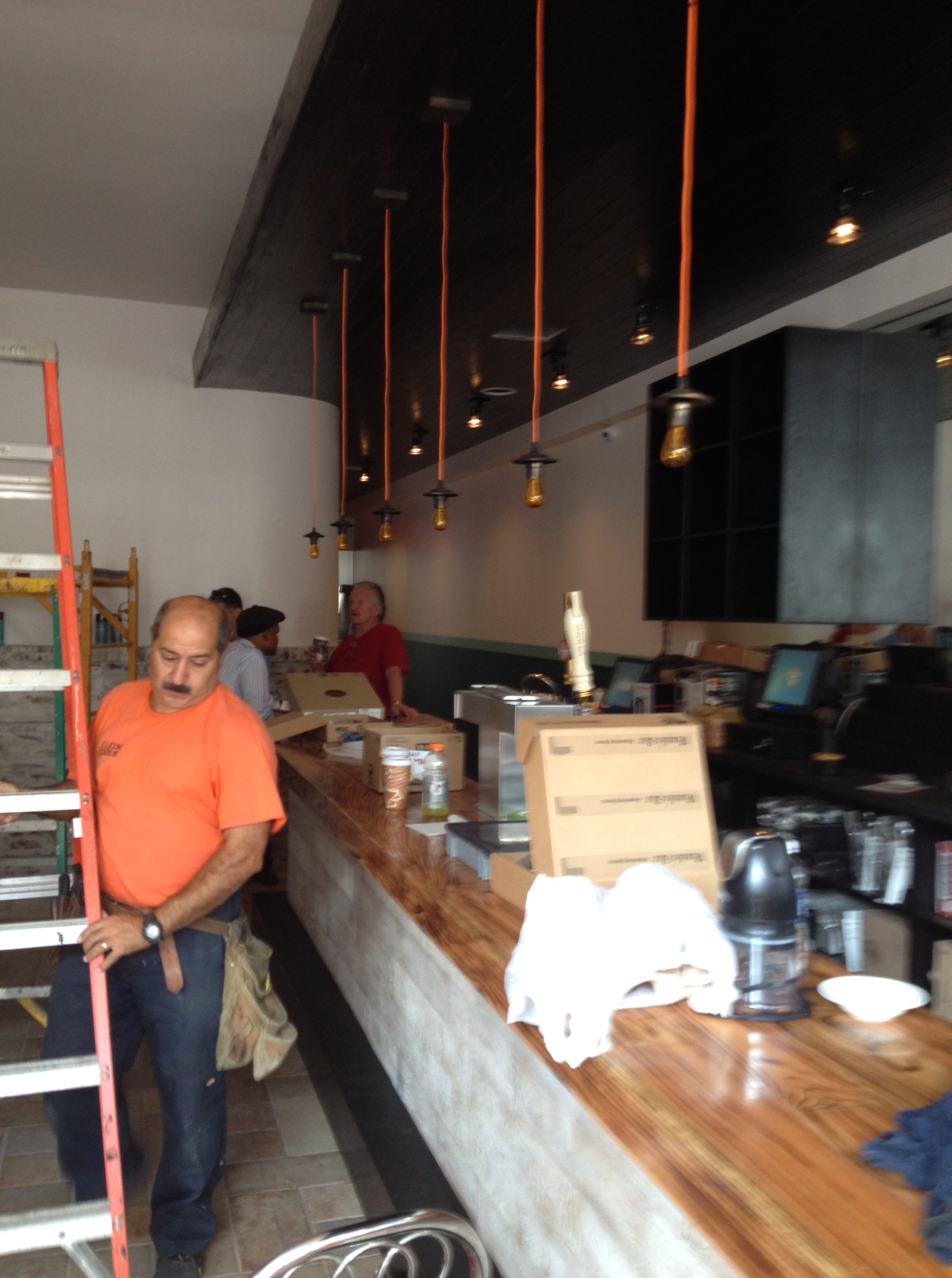
Despite the flip-flops, Chris Miles had clearly come to his restaurant to work. He wore a pair of frayed camouflage shorts and a white “Connelly’s Rockaway Beach 2013” t-shirt that was peppered with holes, slightly exposing his tan skin. As he sat in a dining room full of unwrapped furniture, contractors worked diligently, installing new lights and booths in the bar area. The room was electric with determination.

On Oct. 17, nearly a year to the day that Sandy wiped out his seafood restaurant on Beach 129th Street, Miles and his business partner Bill Keating reopened the business as Pico, a Mexican eatery. It’s been a long time coming. A year ago, Sandy took dead aim at the neighborhood of Belle Harbor, and filled Rockaway Seafood Co. with three feet of ocean. The storm’s massive tidal swells caused an electrical short and sparked a fire around 130th Street. While the fire didn’t consume the entirety of Miles’s business, it did kiss the rear of the building, burning out a storage room and a 15 by 20 foot section of the roof. The next morning, tables and chairs were strewn about, the building smelled of smoke, and there was a three-foot-high stripe on every wall. “Basically the only equipment that was above water were the compressors and the walk-in boxes, and those got burnt out by flames,” Miles chuckled and shook his head.  “So if the water didn’t get you, the fire did.” After starting as a general manager there, he had just bought the restaurant in April.

Like so many others in Rockaway, Miles had to navigate through a tangled web of insurance forms and government programs to receive any money for the destruction. “It took like eight months before we got any money,” he said. Though he wouldn’t get into specifics regarding repair costs, he noted that the majority of the restoration was paid out of his own pocket. His case was especially complicated because Rockaway Seafood Co. had fire and water damage.

photo 1

While the restaurant was in limbo, Miles spent a great deal of free time volunteering with a friend who created Friends of Rockaway, a non-profit organization to help rebuild the waterlogged homes in Rockaway.

Megan Corley, volunteer coordinator for Friends of Rockaway, organizes the vigilante group of rebuilders and described how the non-profit was formed. “Two Rockaway natives came back after the storm to help their own families and work on their homes,” Megan explained. “They quickly started helping neighbors and people in the community, and it just grew from there.”

Today, Friends of Rockaway operates out of a donated house and is composed entirely of volunteers, working like carpenter ants to methodically rebuild homes in the area. Typical services include digging out and cleaning basements, drywall installation, and interior painting. The organization has fully rebuilt 18 homes and has dug out over 600 others.

As a volunteer with the group, Miles took it upon himself to help other local companies with their paperwork. “I kind of handled the small business initiative where I went around to all the businesses and taught them about loans.” Miles said. “A lot of these people had no clue.”

Miles mentioned one woman named Sunny who struggled with English and owned a nail salon on 116th Street. Like many others in Rockaway, Sunny had no idea about the recovery programs available. With Miles’s help, the language barrier between her and the government became a non-issue. “She ended up getting a nice loan and a real nice grant, like an $8,000 grant, which she never would have known about.”

photo 3

As Miles continued to rattle off names of people he and the organization have helped, mentioning each by their first name and even diving into their backstories and personal lives, it became apparent that this community, though battered by a natural disaster, was keen on recovering as a group.

And recover they did. The neighborhood looks far removed from the nautical graveyard depicted on cable news just a year ago. It will still be a while until Rockaway Beach is back to being the tourist hot spot of yesteryear. Until then, Miles will continue to personify the friendly “chip on the shoulder” attitude shared by many of Rockaway’s residents — down but not out. Bruised but not broken.

“We’ve been closed for eleven months. This is my income. I haven’t really worked. I have two small mortgages,” he said. “Am I pretty deep in debt right now? Yeah. Does it stink? Yeah.” And then he knocked twice on the oak table. “It’s going to come back.”

Miles describes Pico as a “local place,” but with its freshly unwrapped image, it seems destined to lure more diners from Queens, Brooklyn, and even Manhattan. “The word Pico on its own translates to something positive — peak, as in peak performance, peak of the mountain,” Miles explained. “And it’s easy to say and it’s not cheesy.”