Five ways to bring summer on the road

Sean McFarland

This article was originally published on BBC Autos.


Winter has retreated from the northern hemisphere and warmth reigns supreme, setting many readers to dream of escapes. Not just any escapes, but the kind of adventures where the vehicle is as much a protagonist as the destination. Few things are better than a car filled with friends en route to a beach or campsite, and the fun factor only grows when a car can adjust for prolonged absences. These are some of our favourite ways to stay away a little bit longer this summer. (Photo: AT Overland Equipment; Cover photo: Kylie McLaughlin/Lonely Planet Images/Getty)

Audi Q3 Camping Tent

The Q3 stuffs Audi’s core tenets of sport and luxury into an appealing soft-roader package. But for weekenders who’d rather not be fodder for mosquitos, Audi has devised a solution. The Q3 camping tent can withstand winds of up to 43mph, making it a formidable shelter in an impromptu storm. Audi estimates that the inflatable fortress and attached exoskeleton will be ready for occupants in just seven minutes. Don’t want to get wet walking from the car to the tent? Fear not, for Ingolstadt’s engineers have thought of it all: the tent attaches seamlessly to the Q3’s open rear hatch, enabling crawl-throughs. How very civilised. (Photo: Audi of America)

Volkswagen California

Grandchild of the recently deceased Kombi, the California is Volkswagen’s response to adventurers seeking a self-contained holiday. The California comes standard with an accordion-like expandable roof, cooking facilities, a sink and a refrigerator. Add the optional camping pack, and a retractable awning turns this Swiss Army van from an overnight shelter to a second home on wheels. At the end of a long summer day, there’s a double bed for a restful night’s sleep. This latest pop-top VW truly has everything you’d need on a camping holiday, save for a fire pit for roasting weenies and preparing late-night s’mores. (We assume Volkswagen will issue a recall to mend this minor design flaw.) (Photo: Volkswagen Group)

Airstream Autobahn

Fancy having your business associates over for a meeting before a daytrip to the countryside? The Airstream Autobahn is the summer solution for the terrestrial jet set. Airstream takes a standard Mercedes-Benz Sprinter van and adds all the humble road-trip necessities: leather-lined captain’s chairs, power window shades, a beverage cooler and, of course, a flat-screen LCD television. Though a journey in the Autobahn would never be construed as “rouging it”, this modified cargo-mover is a choice shelter for those with high-tag adventuring in mind – a tag starting at $133,000 in the US, to be exact. (Photo: Airstream)

Nissan Titan Bed Tent

Notwithstanding nomadic tribes of surfers and snowboarders, most owners of pickup trucks overlook their vehicles’ ability to double as makeshift campgrounds. This bed tent for Nissan’s full-size Titan comes directly from the Japanese brand, and is ideal for providing a dry night’s sleep. But while the shelter part of the camping equation is covered, it’s still in adventurers’ best interest to throw in a mattress. The steel bed of a full-size truck may be a bit on the firm side. (Photo: Nissan North America)

AT Overland JK Habitat

This solution is built for the daytrips that turn into weekend-long trailblazing expeditions. Jeep Wrangler owners end up in the darnedest situations as it is. They might park for the evening in fender-deep mud, simply because they could. For just such occasions, the JK Habitat lofts its residents above the vehicle. This origami nest bolts directly to the body of a Wrangler Unlimited (the Jeep’s four-door configuration) and unfolds to reveal a 15ft-long canvas penthouse. Setup takes just 60 seconds, according to the manufacturer, and the unit can sleep four comfortably. An opening at the rear of the cabin makes a clever entry point, allowing occupants to move upstairs without exiting the vehicle – a smart idea considering the tricky footing in typical Wrangler habitat. (Photo: AT Overland Equipment)

AEV Jeeps make Icelandic landfall

Sean McFarland

This article was originally published on BBC Autos.


Who said fun had to be good and clean? Sometimes the best adventures are those that leave calloused hands and scuffed boots.

Ever since BBC Autos’ recent muddy mingle with Land Rover in Kentucky, a palpable craving for off-road adventure has coursed through our ranks. Vicarious thrills have had to do, but as this video from American Expedition Vehicles (AEV) demonstrates, the thrills can still be quite visceral.

This production comes from Iceland, a place that is – as we’ve learned – tailor-made for off-tarmac adventuring. With a population of less than 300,000 and a bounty of craggy landscapes and slippery surfaces, Iceland is prime country for an off-road tuning company like AEV. The Michigan-based modifiers of all things Jeep Wrangler took a pair of their JK350 Wranglers on the expedition through Iceland’s deep ravines, vast rivers and gritty sands.

This isn’t your average slushy drive to the grocery. AEV’s purpose-built rigs have lifted suspensions and knobby off-road tires designed specifically to handle this type of pockmarked landscape without hesitation.

Slipping and sliding in the colder months is a skill worth acquiring, even outside the confines of a nearly indestructible 4×4. Meantime, spend some good, clean fun inside AEV’s cinematic road trip.

The horseless carriage, electrified in New York

Sean McFarland

This article was originally published on BBC Autos.

Horseless eCarriage

With animal rights activists calling for the end of the horse-drawn carriage era, several companies have begun fielding equine-friendly alternatives. One proposal put forth by a Florida company at the 2014 New York auto show attempts to preserve the romance of a cruise through Manhattan’s most famous park, without the horsepower.

The horse-drawn carriages of Central Park have been a staple of New York City tourism since the early 1900s. But while these chariots carry thousands of awe-struck visitors through New York City’s largest park every year, they have recently come under attack, with critics – including Mayor Bill de Blasio – citing what they call inhumane treatment and boarding of the animals at the front.

Horseless eCarriage

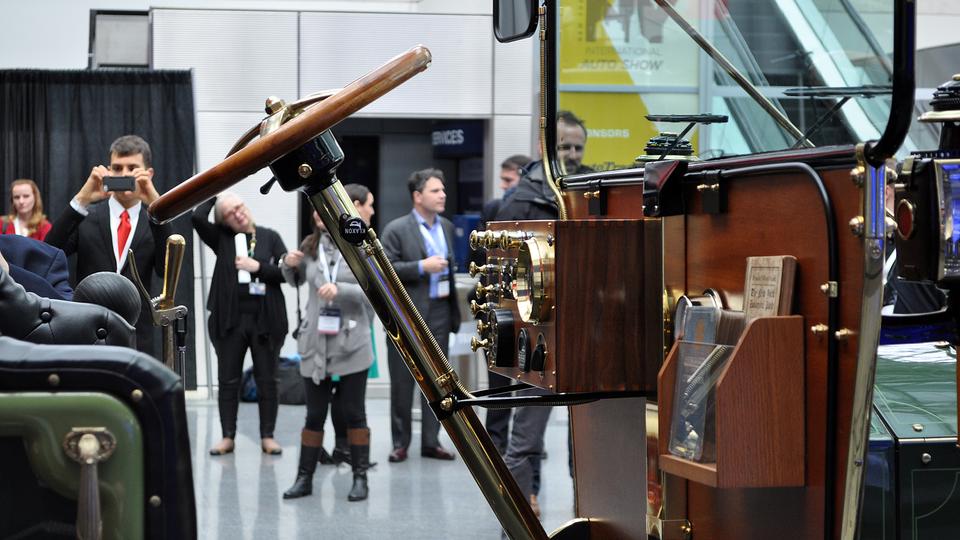
Jason Wenig, owner of a high-end coachwork and fabrication business, The Creative Workshop, proposes the Horseless eCarriage. This electric leviathan is a homage to the classic cars of the “brass era”. However, unlike the polished vehicles of the early 20th century, Wenig’s creation is electric.

With a claimed 100-mile range, the front-engine, rear-drive coach generates the equivalent of 84 horsepower and a top speed of 30 mph. Charging its lithium iron phosphate battery from a 220-volt outlet should take six hours, according to the company. For a vehicle that weighs about 7,500lbs when filled to its eight-passenger capacity, this carriage is no dainty surrey with a fringe on top.

Horseless eCarriage

The green and black carriage is awash in clever details, such as LED turning signals housed in oil lamps, three-abreast rear seating and even historical New York guidebooks on the seatback. For all this, Wenig argues that his creation is cheap to build and maintain – at least relative to keeping a team of horses in hay.

The eCarriage, however, is no shoe-in. It must secure political backing, both from elected officials and in the form of grant money to offset vehicle costs to carriage operators – who work privately. Regardless of whether this creation ends up seeing Center Drive,  its nostalgia-baiting design and sheer girth are enough to overshadow many cars at the auto show.

(Photo credit: Sean McFarland)

5 Bicycle Events You Have To Experience In New York City In 2014

Sean McFarland

Just because New York City is currently as tropical as an arctic tundra doesn’t mean that it’s too early to look forward to the best bicycle events of the 2014 season. It’s time to tune up your bike, order that fancy new jersey, and prepare for the warmer months to come. Here’s just a quick look at the top events to look for in 2014.

1. Time’s Up NYC’s Night Rides

Time’s Up NYC is an organization that actively fights for increased bicycle infrastructure. The group hosts Manhattan’s monthly version of Critical Mass—a nationwide, politically driven ride that emphasizes “more bikes, less cars.” But whether or not you’re into bicycle politics, they also host some pretty killer rides. Time’s Up NYC also hosts monthly “Moonlight Rides” through Central Park and Prospect Park. Bike guides usher the group from the front and rear of the pack and act as tour guides at several scenic stopping points. The rides are leisurely and typically cover about 10 miles, making them an ideal choice for a casual bicyclist. Best of all, they’re totally free.

Who this event is good for: Riders of all abilities.

Prices: Free.

When/Where: Central Park rides meet at Columbus Circle on the first Friday of each month at 10 p.m. Prospect Park rides meet at the Grand Army Plaza in Brooklyn on the second Saturday of each month at 9 p.m.

What you’ll need: Any bicycle, lights are recommended.

2. Bike Polo

There is no sport more unique and more obscure than bicycle polo. This year, New York’s League of Bike Polo returns for another season of pickup polo at “The Pit” in Chinatown and in Fort Greene in Brooklyn. Unlike traditional polo, a bike polo match takes place on a hard surface such as a basketball or tennis court and is played, well, on a bike. Each team has three players who must use their mallet to smack the ball into the opposing team’s goal. The other rules are simple: a player’s feet may not touch the ground, games are scored to either three or five, and trash talking is allowed. The meets are informal and open to anyone who seeks to try their hand at one of New York’s most uncommon sports.

Who this event is good for: Casual riders seeking a social and competitive adventure.

Prices: Free.

When/Where: Thursdays from 5 p.m. to 7 p.m. and Sundays from 2 p.m. until 7 p.m. at “The Pit” in the Lower East Side at the corner of Chrystie street and Delancey. In Brooklyn, the league meets at North Oxford and Flushing on Tuesdays from 6 p.m. to 9 p.m. and Thursdays from 7 p.m. to 10 p.m.

What you’ll need: A bicycle, and a polo mallet, typically homemade.

3. 2014 Red Hook Criterium

The most intimidating bike race in New York City rolls back into Brooklyn on March 29th at the Brooklyn Cruise Terminal. Why is it intimidating? Well not only is the Red Hook Crit a 24-lap scramble on a track that’s hardly wider than a one-way street, but it also manages to cram almost 100 riders on said track. Out of the 200 that attempt to qualify for the race, 85 brave souls will race nonstop for 31.5 kilometers in a race that’s for track bikes only. The women’s event, which runs the same course is even more exclusive—only 50 slots are open for race day. While their race is slightly shorter at 18 laps, it’s no less intimidating. Luckily, if you’re not up for the task of entering this gauntlet of a race, the Red Hook Crit is still perhaps the greatest cycling spectacle in New York City. However, spectators beware: this event can get dicey.

Who this event is good for: Seasoned amateur and professional racers.

Prices: Registration is $50.

When/Where: March 29th at the Brooklyn Cruise Terminal. Qualifying begins at 1 p.m. and races start at 9 p.m.

What you’ll need: A track bike with drop handlebars, clipless pedals, and a helmet. Time trial wheels are not allowed.

4. TD Five Boro Bike Tour

The Ebenezer Scrooges of the bicycling community frown on the Five Boro Bike Tour. Yes, its crowds of over 32,000 cyclists can create some of the biggest bottlenecks in human history. Yes, it’s open to cyclists of all kinds, meaning your goals of a 90+ cadence throughout the 40-mile course is unlikely. Yes, the “wide open” streets of New York City won’t be really open. However, this event is one of the simplest ways to get people to ride—aside from registration, the only thing you’ll need is a helmet! The host, Bike New York, even puts on workshops to teach people how to ride beforehand. Because of this arms-wide-open attitude, the event is notable for being one of the few events that bring the community together on such a large scale. Bicyclists of all shapes and sizes are welcome to join this trek through each of New York City’s unique boroughs.

Who this event is good for: Riders of all abilities.

Prices: Standard registration is $90, and VIP registration is $325.

When/Where: The ride begins at Battery Park on May 4th.

What you’ll need: A helmet, and a rider identification kit from Bike New York. This consists of a helmet cover, bib, and a bike plate.

5. NYC Century Bike Tour

The NYC Century Bike Tour isn’t as intense as it sounds. Riders do have the opportunity to complete the signature 100-mile ride, but as in previous years, they’re also given the option for rides of 75, 55, 35, or 15-mile lengths, allowing riders of all intensities to participate. What makes this ride unique, however, is that while there are specific routes to follow that highlight many of New York’s unique neighborhoods, the event is not held on closed roads. Rather, it forces riders to navigate through traffic. Transportation Alternatives, an organization dedicated to reclaiming the streets from the automobile, uses the event as a platform to highlight New York City’s increasingly impressive bicycle infrastructure. http://nyccentury.org/The group has yet to post specifics, but since 2014 will mark the event’s 25th anniversary, expect them to go big this year.

Who this event is good for: Riders of all abilities.

Prices: Early registration is $55 for non-members, $45 for members, and $25 for kids.

When/Where: Specific date TBD, likely early September. Rides depart from Central Park and Prospect Park.

What you’ll need: Any bicycle. Helmets are required for kids, recommended for adults.

Eye Wall of Relief

Sean McFarland

This article is also published on New York Magazine‘s Bedford & Bowery website.

IMG_2942

Despite the flip-flops, Chris Miles had clearly come to his restaurant to work. He wore a pair of frayed camouflage shorts and a white “Connelly’s Rockaway Beach 2013” t-shirt that was peppered with holes, slightly exposing his tan skin. As he sat in a dining room full of unwrapped furniture, contractors worked diligently, installing new lights and booths in the bar area. The room was electric with determination.

On Oct. 17, nearly a year to the day that Sandy wiped out his seafood restaurant on Beach 129th Street, Miles and his business partner Bill Keating reopened the business as Pico, a Mexican eatery. It’s been a long time coming. A year ago, Sandy took dead aim at the neighborhood of Belle Harbor, and filled Rockaway Seafood Co. with three feet of ocean. The storm’s massive tidal swells caused an electrical short and sparked a fire around 130th Street. While the fire didn’t consume the entirety of Miles’s business, it did kiss the rear of the building, burning out a storage room and a 15 by 20 foot section of the roof. The next morning, tables and chairs were strewn about, the building smelled of smoke, and there was a three-foot-high stripe on every wall. “Basically the only equipment that was above water were the compressors and the walk-in boxes, and those got burnt out by flames,” Miles chuckled and shook his head.  “So if the water didn’t get you, the fire did.” After starting as a general manager there, he had just bought the restaurant in April.

Like so many others in Rockaway, Miles had to navigate through a tangled web of insurance forms and government programs to receive any money for the destruction. “It took like eight months before we got any money,” he said. Though he wouldn’t get into specifics regarding repair costs, he noted that the majority of the restoration was paid out of his own pocket. His case was especially complicated because Rockaway Seafood Co. had fire and water damage.

photo 1

While the restaurant was in limbo, Miles spent a great deal of free time volunteering with a friend who created Friends of Rockaway, a non-profit organization to help rebuild the waterlogged homes in Rockaway.

Megan Corley, volunteer coordinator for Friends of Rockaway, organizes the vigilante group of rebuilders and described how the non-profit was formed. “Two Rockaway natives came back after the storm to help their own families and work on their homes,” Megan explained. “They quickly started helping neighbors and people in the community, and it just grew from there.”

Today, Friends of Rockaway operates out of a donated house and is composed entirely of volunteers, working like carpenter ants to methodically rebuild homes in the area. Typical services include digging out and cleaning basements, drywall installation, and interior painting. The organization has fully rebuilt 18 homes and has dug out over 600 others.

As a volunteer with the group, Miles took it upon himself to help other local companies with their paperwork. “I kind of handled the small business initiative where I went around to all the businesses and taught them about loans.” Miles said. “A lot of these people had no clue.”

Miles mentioned one woman named Sunny who struggled with English and owned a nail salon on 116th Street. Like many others in Rockaway, Sunny had no idea about the recovery programs available. With Miles’s help, the language barrier between her and the government became a non-issue. “She ended up getting a nice loan and a real nice grant, like an $8,000 grant, which she never would have known about.”

photo 3

As Miles continued to rattle off names of people he and the organization have helped, mentioning each by their first name and even diving into their backstories and personal lives, it became apparent that this community, though battered by a natural disaster, was keen on recovering as a group.

And recover they did. The neighborhood looks far removed from the nautical graveyard depicted on cable news just a year ago. It will still be a while until Rockaway Beach is back to being the tourist hot spot of yesteryear. Until then, Miles will continue to personify the friendly “chip on the shoulder” attitude shared by many of Rockaway’s residents — down but not out. Bruised but not broken.

“We’ve been closed for eleven months. This is my income. I haven’t really worked. I have two small mortgages,” he said. “Am I pretty deep in debt right now? Yeah. Does it stink? Yeah.” And then he knocked twice on the oak table. “It’s going to come back.”

Miles describes Pico as a “local place,” but with its freshly unwrapped image, it seems destined to lure more diners from Queens, Brooklyn, and even Manhattan. “The word Pico on its own translates to something positive — peak, as in peak performance, peak of the mountain,” Miles explained. “And it’s easy to say and it’s not cheesy.”