Sean McFarland
This article is also published on New York Magazine‘s Bedford & Bowery website.

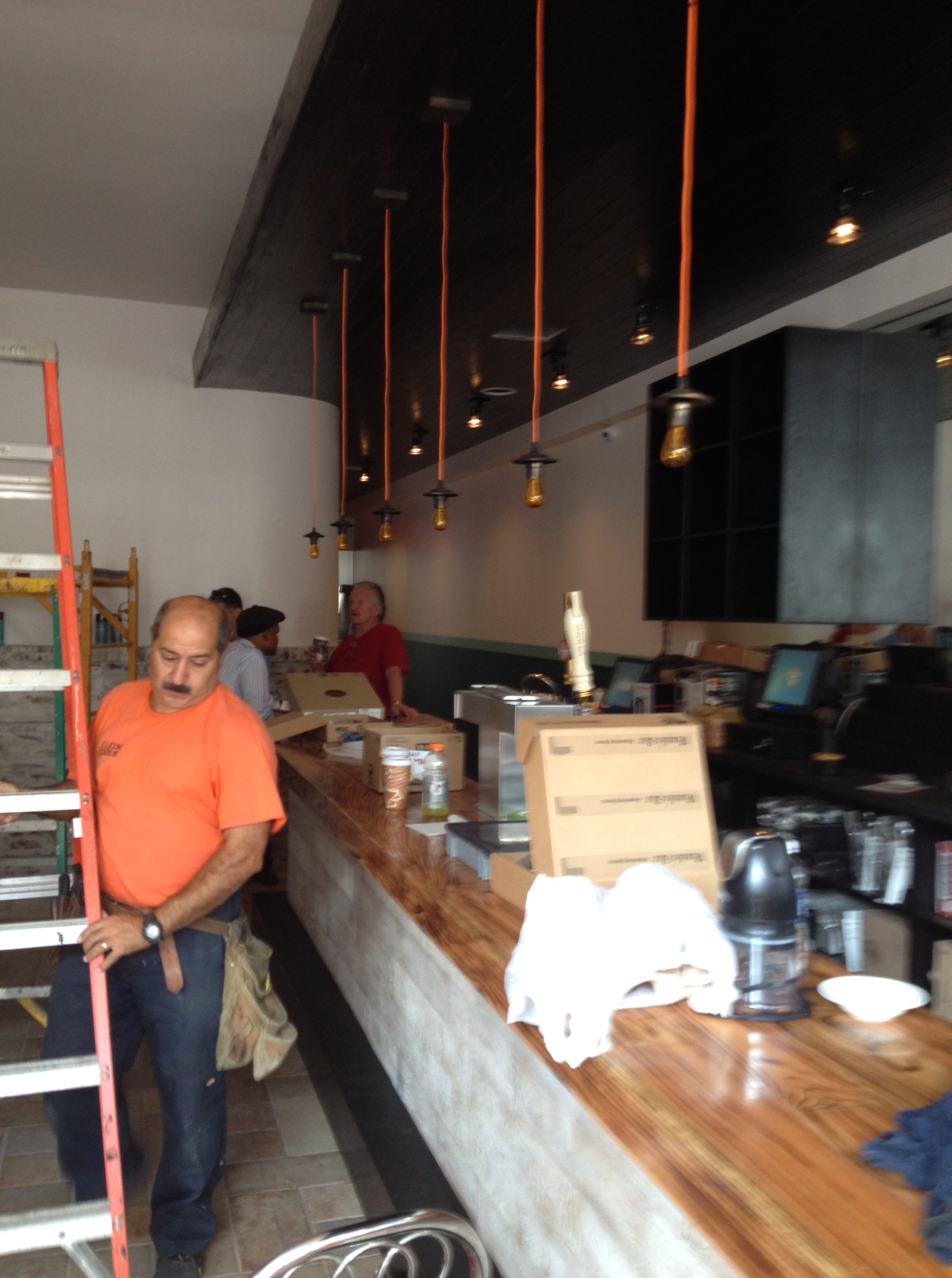
Despite the flip-flops, Chris Miles had clearly come to his restaurant to work. He wore a pair of frayed camouflage shorts and a white “Connelly’s Rockaway Beach 2013” t-shirt that was peppered with holes, slightly exposing his tan skin. As he sat in a dining room full of unwrapped furniture, contractors worked diligently, installing new lights and booths in the bar area. The room was electric with determination.
On Oct. 17, nearly a year to the day that Sandy wiped out his seafood restaurant on Beach 129th Street, Miles and his business partner Bill Keating reopened the business as Pico, a Mexican eatery. It’s been a long time coming. A year ago, Sandy took dead aim at the neighborhood of Belle Harbor, and filled Rockaway Seafood Co. with three feet of ocean. The storm’s massive tidal swells caused an electrical short and sparked a fire around 130th Street. While the fire didn’t consume the entirety of Miles’s business, it did kiss the rear of the building, burning out a storage room and a 15 by 20 foot section of the roof. The next morning, tables and chairs were strewn about, the building smelled of smoke, and there was a three-foot-high stripe on every wall. “Basically the only equipment that was above water were the compressors and the walk-in boxes, and those got burnt out by flames,” Miles chuckled and shook his head. “So if the water didn’t get you, the fire did.” After starting as a general manager there, he had just bought the restaurant in April.
Like so many others in Rockaway, Miles had to navigate through a tangled web of insurance forms and government programs to receive any money for the destruction. “It took like eight months before we got any money,” he said. Though he wouldn’t get into specifics regarding repair costs, he noted that the majority of the restoration was paid out of his own pocket. His case was especially complicated because Rockaway Seafood Co. had fire and water damage.

While the restaurant was in limbo, Miles spent a great deal of free time volunteering with a friend who created Friends of Rockaway, a non-profit organization to help rebuild the waterlogged homes in Rockaway.
Megan Corley, volunteer coordinator for Friends of Rockaway, organizes the vigilante group of rebuilders and described how the non-profit was formed. “Two Rockaway natives came back after the storm to help their own families and work on their homes,” Megan explained. “They quickly started helping neighbors and people in the community, and it just grew from there.”
Today, Friends of Rockaway operates out of a donated house and is composed entirely of volunteers, working like carpenter ants to methodically rebuild homes in the area. Typical services include digging out and cleaning basements, drywall installation, and interior painting. The organization has fully rebuilt 18 homes and has dug out over 600 others.
As a volunteer with the group, Miles took it upon himself to help other local companies with their paperwork. “I kind of handled the small business initiative where I went around to all the businesses and taught them about loans.” Miles said. “A lot of these people had no clue.”
Miles mentioned one woman named Sunny who struggled with English and owned a nail salon on 116th Street. Like many others in Rockaway, Sunny had no idea about the recovery programs available. With Miles’s help, the language barrier between her and the government became a non-issue. “She ended up getting a nice loan and a real nice grant, like an $8,000 grant, which she never would have known about.”

As Miles continued to rattle off names of people he and the organization have helped, mentioning each by their first name and even diving into their backstories and personal lives, it became apparent that this community, though battered by a natural disaster, was keen on recovering as a group.
And recover they did. The neighborhood looks far removed from the nautical graveyard depicted on cable news just a year ago. It will still be a while until Rockaway Beach is back to being the tourist hot spot of yesteryear. Until then, Miles will continue to personify the friendly “chip on the shoulder” attitude shared by many of Rockaway’s residents — down but not out. Bruised but not broken.
“We’ve been closed for eleven months. This is my income. I haven’t really worked. I have two small mortgages,” he said. “Am I pretty deep in debt right now? Yeah. Does it stink? Yeah.” And then he knocked twice on the oak table. “It’s going to come back.”
Miles describes Pico as a “local place,” but with its freshly unwrapped image, it seems destined to lure more diners from Queens, Brooklyn, and even Manhattan. “The word Pico on its own translates to something positive — peak, as in peak performance, peak of the mountain,” Miles explained. “And it’s easy to say and it’s not cheesy.”


 Sean McFarland